IS DIGITAL PHOTOGRAPHY
THE NEW EXPRESSIVE
VISUAL ART?
By Rick Doble

Rick Doble has been a professional photographer for over 30 years. His
digital photographs and computer art work are reaching a world-wide
audience both on the Internet (over 35,000 unique hits last year) and
at various museum shows. He will be included in the next edition of Who'sWho
in America (the original Who'sWho since
1899).
NOTE: One year ago Rick Doble wrote an article about digital
photography that was reprinted at six different Internet sites around
the world. This is a follow-up to that article.
See the following related exhibits and articles:
---Read the original article written a year ago:
Thoughts About Using A
Digital Camera By Rick Doble
---See the full exhibit of experimental carnival pictures:
" I see those carny
lights! " experimental digital photography at a fall carnival
---See my article at the DigiGallery zine:
The
Digital Way to Experiment by Rick Doble
NOTE: Place the mouse pointer over a picture for more
information about that digital image.
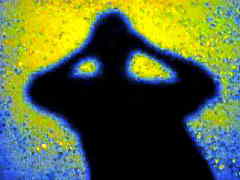 Digital photography could be a major art form in
the next century. It may be the culmination of the development of
photography. I have been working with a very simple Casio QV-100 camera
for over a year, and I am still amazed at the variety and depth of
imagery I can achieve without a flash or a zoom lens. (Of course I will
eventually get a more sophisticated camera, but not until I have
exhausted every aspect of this basic Casio.)
Digital photography could be a major art form in
the next century. It may be the culmination of the development of
photography. I have been working with a very simple Casio QV-100 camera
for over a year, and I am still amazed at the variety and depth of
imagery I can achieve without a flash or a zoom lens. (Of course I will
eventually get a more sophisticated camera, but not until I have
exhausted every aspect of this basic Casio.)
Read on and I will explain why I think digital photography is so
different from previous photography and why I think it has such great
potential.
Many people do not realize and even experienced photographers can
forget, that photography is all about light. Photography literally
means light (photo) writing (graphy). The
action of light on film (*1)
creates the image.
As I used to teach in a basic photography class 25 years ago,
photography is not about objects or people or scenery. Rather it is
about how the light reveals those things. As any beginning photography
student knows, a cube can be lighted so that it almost disappears or so
that it is virtually three dimensional. The key is the light.
These images were not manipulated in PhotoShop or other
graphics software. All these effects were created with traditional
photographic adjustments in a basic darkroom program.
Color photography is a relatively recent invention. Taking pictures in
color means that it is not only the intensity of the light, but also
the color of the light that creates the image. Yet color is not simple.
For example, a scene may include several light sources which have their
own particular color. There are many subtle aspects to working with
color film.
In the middle of this century, the single lens reflex (SLR) camera was
a technical breakthrough. For the first time the photographer could see
exactly what the lens saw. This solved a number of problems such as
parallax. Digital photography goes one step further and lets the artist
see what the film is
seeing in " real time " on a LCD screen(*2).
Digital photography is a radically different kind of
photography, because the photographer can finally see what the film
sees. This is more important that the ability to manipulate the image
in a computer.
This is especially important in color photography because different
light sources (color temperatures and wave lengths) and subtleties of
color may be seen differently by the film than by the human eye. 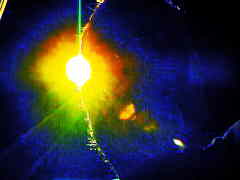 For example, various street
lamps can be seen by film as having unusual colors. This street lamp
pictured here on the left looked simply yellow to my human eye, but
appeared to have many colors on film.
For example, various street
lamps can be seen by film as having unusual colors. This street lamp
pictured here on the left looked simply yellow to my human eye, but
appeared to have many colors on film.
I sometimes like to add flare to my pictures which can produce a
rainbow of colors. I have found that most lights have a precise point
where the camera must be aligned to get the full effect of flare.
Before the digital LCD screen this kind of exact positioning was
impossible.
 For a variety of reasons the real time LCD screen lets a photographer "
paint with light, " light that is in the real world. While some of
these effects could be approximated with the aid of a computer, images
created in the real world have a vitality to them that a computer
manipulated image cannot approach. It is the difference between the
real and the artificial. I believe the real world has much more power.
For example, the true story of the Titanic grabs us more than the
fictional story of a luxury liner disaster such as " The Poseidon
Adventure. "
For a variety of reasons the real time LCD screen lets a photographer "
paint with light, " light that is in the real world. While some of
these effects could be approximated with the aid of a computer, images
created in the real world have a vitality to them that a computer
manipulated image cannot approach. It is the difference between the
real and the artificial. I believe the real world has much more power.
For example, the true story of the Titanic grabs us more than the
fictional story of a luxury liner disaster such as " The Poseidon
Adventure. "
There is another aspect to this LCD screen: it allows a photographer to
review pictures that he or she just shot. Again this is a radical
development. Immediate feedback is vital to learning.
In a personal note I have spent years trying to shorten the time
between taking pictures and seeing the developed images. I have used
black and white slides and color slides that I processed immediately,
along with instant Polaroids. When not using any of these techniques, I
developed negative film on the same day it was shot and made contact
sheets to get some idea of what I had just done.
There are many psychological studies that point to the importance of
feedback in learning. People who aimed bullets at a target, but were
not told where the bullets hit until later, could not learn quickly.
However, those who were told immediately improved rapidly. While this
seems obvious, it is often forgotten. (Sorry for the gun example, but
that is what the study involved.)

Digital photography allows an artist to learn quickly in new
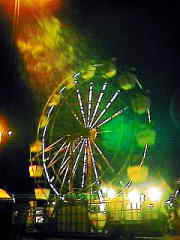
situations. For example, I took pictures at a fall carnival (see
picture at left) and wanted to get a sense of movement with blurred
images. Blurred images are bad for your vision, but can be cool in photography. When the pictures did not turn out as I hoped, I started to
move the camera in relation to the ferris wheel. In less that one hour
I went from traditional night shots to some of the most unusual
pictures I have ever taken. The immediate feedback was crucial.
See the full exhibit of
these experimental pictures.
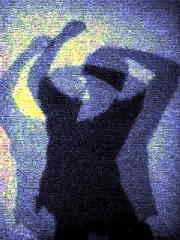 There are many, many ways to experiment. See my article at the
DigiGallery zine on digital
photography experiments.
There are many, many ways to experiment. See my article at the
DigiGallery zine on digital
photography experiments.
The bottom line is this: in the past still photography couldn't get no
respect, color photography in particular. It was rarely considered a
valid art form. It was thought of as a mechanical process, or a trade
rather than having any potential for an artistic vision. Of course,
those of us in photography knew better.
Now with digital photography, those with artistic ideas can realize
their imagery in strikingly individual and unique ways. A full
understanding of light and color means that, in the hands of a master,
modern photography is a rich, complicated, sophisticated and expressive
art form. Even the permanence of color photography has been solved with
the digital process because the digital file can be stored indefinitely
(see my original article
on digital photography).
My own personal quest in photography involves a number of " purist "
notions added to the capabilities of a digital camera: I try to do most
of my work at the moment of taking the picture rather than later with a
computer. This vital instant is the " decisive moment " of snapping the
shutter as stated by Henri Cartier-Bresson. I believe that the most
powerful images are spontaneous and not reworked. This gives them a
vitality which is similar to the difference in music between a live
concert and a studio recording.  As a result, I rarely crop; I
rarely manipulate the image in a computer graphics or paint program or
in PhotoShop. (Notice the word rarely; never say never.) I do use the
traditional photographic controls of adjusting brightness, contrast,
color balance and range. This is all I need to achieve my effects.
As a result, I rarely crop; I
rarely manipulate the image in a computer graphics or paint program or
in PhotoShop. (Notice the word rarely; never say never.) I do use the
traditional photographic controls of adjusting brightness, contrast,
color balance and range. This is all I need to achieve my effects.
I would like to
propose a new term for this photography. The term is " photo
-expressionism. " (*3)
By this I mean photographic imagery that is both personal and
expressive, photography that is as artistic as the paintings of Vincent
van Gogh, Edvard Munch (The Scream), or Jackson Pollock.
I suggest the term " photo-expressionism " for digital
photographs that are as personal and expressive as the expressionist
paintings of the recent past.
FOOTNOTES:
*1. For the sake of
simplicity I will speak of film and electronic film instead of
electronic light sensitive material or other term for electronic
photographic media. Back to
original paragraph.
*2. The LCD
screen is an approximation and is separate from the electronic film.
All viewing screens show less than the full image (also true for SLRs),
the resolution is much lower than the final image, and the LCD may see
light somewhat differently that the electronic film. There is also a
delay in the " real time " display. If you snap the shutter in a fast
moving situation, you will find you get the next frame, not the one you
thought you got. In short you have to learn to anticipate.
However, the approximation is good enough so that a photographer can
learn to work with it. As in all photographic processes part of the art
is being able to accurately guess how the final image will turn out.
There is only one true image that shows you exactly what you shot; that
is the final output form for your image. A picture displayed on a
computer monitor or on the Internet will look quite different than one
printed out on the best quality photographic paper or reprinted in a
magazine. Photographers find themselves unconsciously adjusting their
imagery to match the final output form. Back
to original paragraph.
*3. I derived
this term from two movements in painting: expressionism as practiced by
German and other painters (Kirchner, Klee, Kandinsky) at the beginning
of the century and abstract expressionism as practiced by artists in
New York in the 1940s and 1950s (Pollock, Rothko, Frankenthaler) along
with others around the world. Also I realize that van Gogh is not
strictly an expressionist, yet his work is considered to be one of the
foundations of expressionism by virtually all critics. Clay Riley, the
director of the local arts council, the Carteret Arts Council, looked
at my work and said that I was " action painting " with a camera. That
thought started me thinking about the idea of photography as an
expressive medium. Back to
original paragraph.
Back to home page.
Go to my
Digital Visuals
site to see a full listing of my visual
work
on the Internet.
Send
me an e-mail message.
© Copyright 1999 by Richard deGaris
Doble
All rights reserved.