Types Of Camera Movement
When you move the camera, you will generally use these types of major movements: panning (left to right or top to bottom or a combination), circular movements, jagged movements and erratic movements. Most of you will end up using a combination of these in a very personal way which is exactly why light painting is so creative and has so many possibilities. I have found that moving the camera in rhythm to music often creates interesting effects.
In addition to the overall movement of the camera, you can introduce a kind of vibration where your hand shakes the camera as it moves in a major pattern. This vibration will add a squiggle to the line that again can give it a very personal touch, not unlike a vibrato in music.
You can also play with keeping the camera more or less in one place while you vibrate it. This often works well when the lights themselves are moving such as the lights of a Ferris Wheel or car lights.
You can also lock your camera in to a position such as inside a car. The movement of the car, then, becomes the camera's movement and this creates rather regular and predictable patterns. Most of you have already seen this kind of photo as it produces a burst type of pattern through the automobile's windshield.
Tip: You may want to turn off the camera's stabilization feature to add more subtle movement or you may want to keep it on for a smooth panning effect.
Also the more extreme the telephoto setting, the more blur occurs naturally. The steadiness (or lack of it) of the photographer's hand is magnified by the telephoto lens. The more extended the zoom telephoto setting, the more blurring will occur. Since the point of light painting is to move the camera, this kind of movement may or may not be desirable.
Speeding up and slowing down as you move also adds another control to your light painting digital photograph. As you speed up you lower the exposure and as you slow down you increase the exposure of each light source.
Types Of Subject Movement
Most lights will be stationary but there are times when the lights themselves will be moving such as the lights of rides at a county fair. Cars also move down the highway and planes come in at night over lighted runways. Light reflected in water will move with the ripples in the water as well as with the wind. Some highway signs rotate as well.
Stationary Objects Relative To The Camera
While lights may be moving and the camera may be moving, there still may be surfaces that are stationary relative to the camera. For example, when I take pictures through the windshield of my car, the windshield and rain on that glass are stationary in relation to the camera. Also the hood of the car is stationary relative to the camera even though the car is moving. See examples.
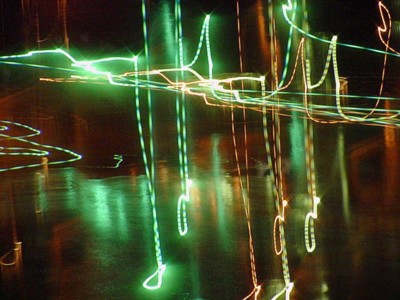
This picture and the next were taken of the same scene. They show how you can get a variety of effects depending on the movements you make.

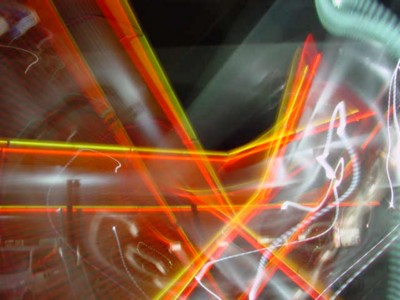
To get this photo I held my camera steady and then moved it in distinct phases. These neon lights are from an outdoor restaurant.
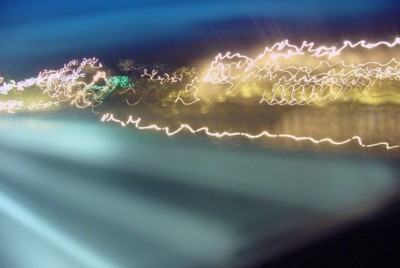
This photo was taken from a car side window as I was going by a factory. I added a bit of hand vibration to give the lights a more interesting look.

